Strip Lining
What is it for?
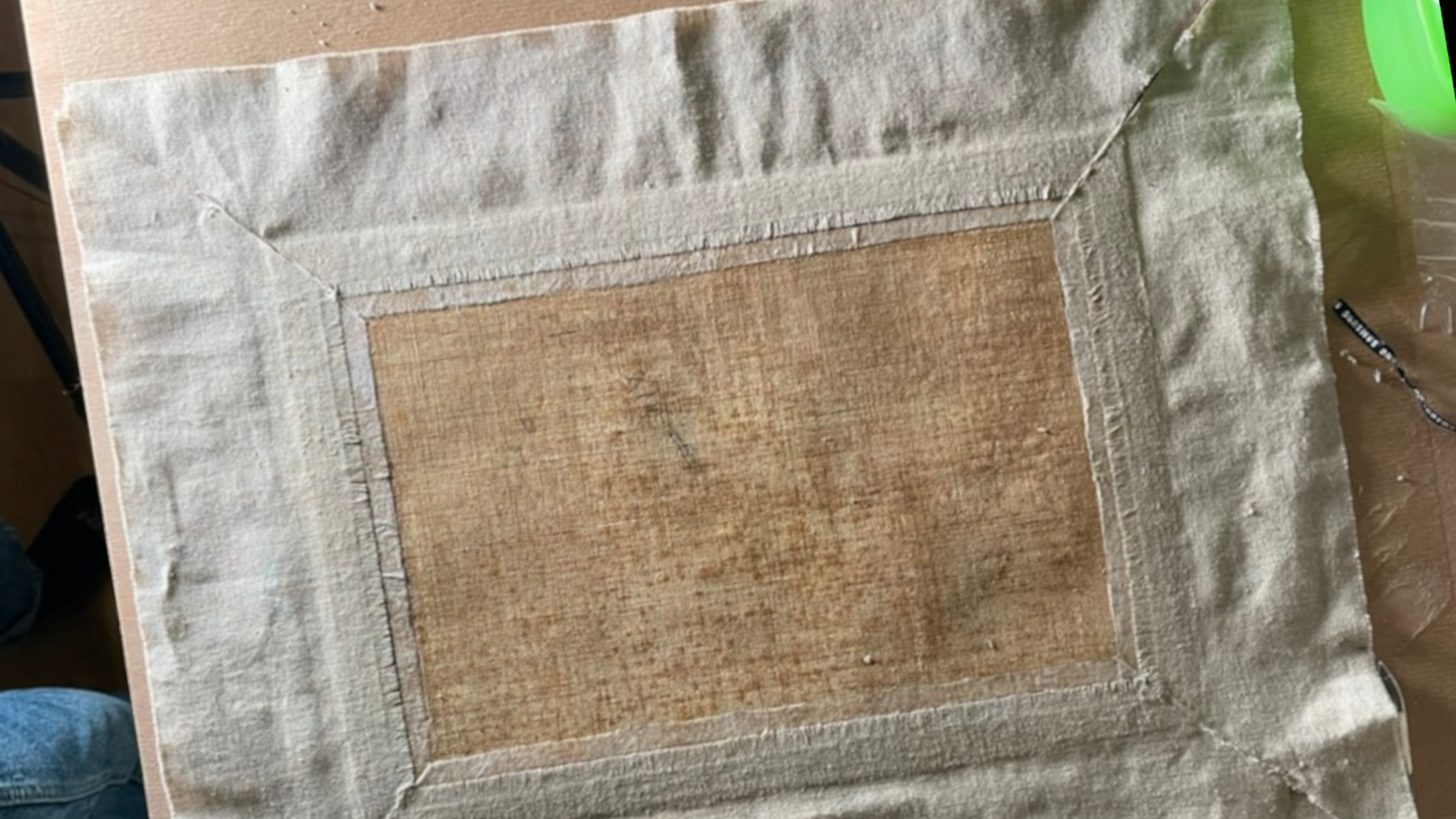
Strip lining is a conservation intervention that consists of reinforcing a canvas’s edges to allow its correct tensioning on a stretcher. This technique is particularly important when a painting original edges are weakened, torn, fragmented or simply too short to allow adequate fixing on the stretcher.
Strip lining application allows to:
Consolidate weakened edges of the canvas without intervening on the painting central part
Widen edges of a canvas too short to reach dimensions necessary for good stretching
Harmoniously distribute tensions on the entire perimeter
Protect original edges against mechanical constraints exercised by nails, staples or other fixing systems
Allow optimal tensioning without risking new tears
A particular stake for contemporary art
In the field of modern and contemporary art, my specialty at Atelier CROMA, strip lining application presents specific problematics:
- Modern industrial canvases have different characteristics requiring adaptation of reinforcement material choice
- Large formats, typical of contemporary art, exercise important mechanical constraints on edges
- Contemporary artwork borders can integrate non-traditional elements (collages, important thicknesses, mixed materials) that need to be taken care of
How I proceed at Atelier CROMA?
As a conservator specialised in modern and contemporary art, I apply a rigorous methodology adapted to each work:
1. Prior diagnosis
Before any intervention, I carry out detailed evaluation:
- Analysis of existing edge condition and their capacity to support tensions
- Evaluation of original weaving to choose a reinforcement canvas with compatible mechanical characteristics
- Observation of tensions currently exercised on the canvas
- Identification of fragility zones on the artwork’s perimeter
- Determination of optimal width of strip lining to apply
2. Selection of adapted materials
For any artworks, I carefully choose:
- Compatible canvases with original support, both in terms of weaving and dimensional stability
- Reversible adhesives adapted to synthetic materials often present in contemporary art
- Intermediate materials ensuring harmonious transition between original support and strip lining
- Specific solutions for borders presenting unconventional materials
3. Precise application techniques
Strip lining application takes place in several meticulous steps:
- Painting edges preparation (cleaning, prior consolidation if necessary)
- Custom cutting of strip lining in adapted textile material
- Controlled fraying of strip edges to create progressive transition with original canvas
- Application of insulating layer to guarantee future intervention reversibility
- Precise gluing of strips with compatible and time-stable adhesive
4. Adaptation to contemporary specificities
For modern and contemporary artworks, I’ve developed specific techniques:
- Strip lining application on industrial canvases whose selvedges are often insufficient or weakened
- Adaptation to non-sized canvases typical of certain contemporary practices requiring compatible adhesives
- Adaptation to synthetic preparations (acrylic, vinyl) that react differently to traditional glues
- Solutions for large formats requiring reinforced strip lining to support important mechanical constraints
- Methods compatible with unvarnished surfaces frequent in contemporary art, requiring particular precautions during application
- Adaptation to loose or irregular weave canvases used by certain contemporary artists
An ecological approach
My environmental approach translates concretely in my strip lining approach:
Privileged use of natural origin textiles well sourced for reinforcement strips
Selection of adhesives with low environmental impact when compatible with the artwork
Preference for cold techniques limiting energy consumption
Possible reuse of original stretchers when their condition permits
When to consider strip lining application?
This intervention may be necessary in various situations:
Frayed or torn edges no longer allowing secure fixing
Insufficient original format to allow adequate mounting on stretcher
Localized weaknesses on canvas perimeter
Work preparation for new mounting on stretcher
Necessary enlargement following presentation format modification
Why choose Atelier CROMA for strip lining application?
As a conservator specialized in modern and contemporary art, Zoé Sallin offers you:
A specific expertise in treating modern and contemporary artworks
In-depth knowledge of textile materials and adhesives adapted to contemporary art
Particular sensitivity to large format problematics
Innovative solutions for complex cases
Ecological commitment in material and method choices
Ask a personalised estimate
Does your artwork present weakened or insufficient edges for correct tensioning? Don’t hesitate to contact me for a personalised diagnosis and a quote adapted to your situation.