Lining
What is it for?
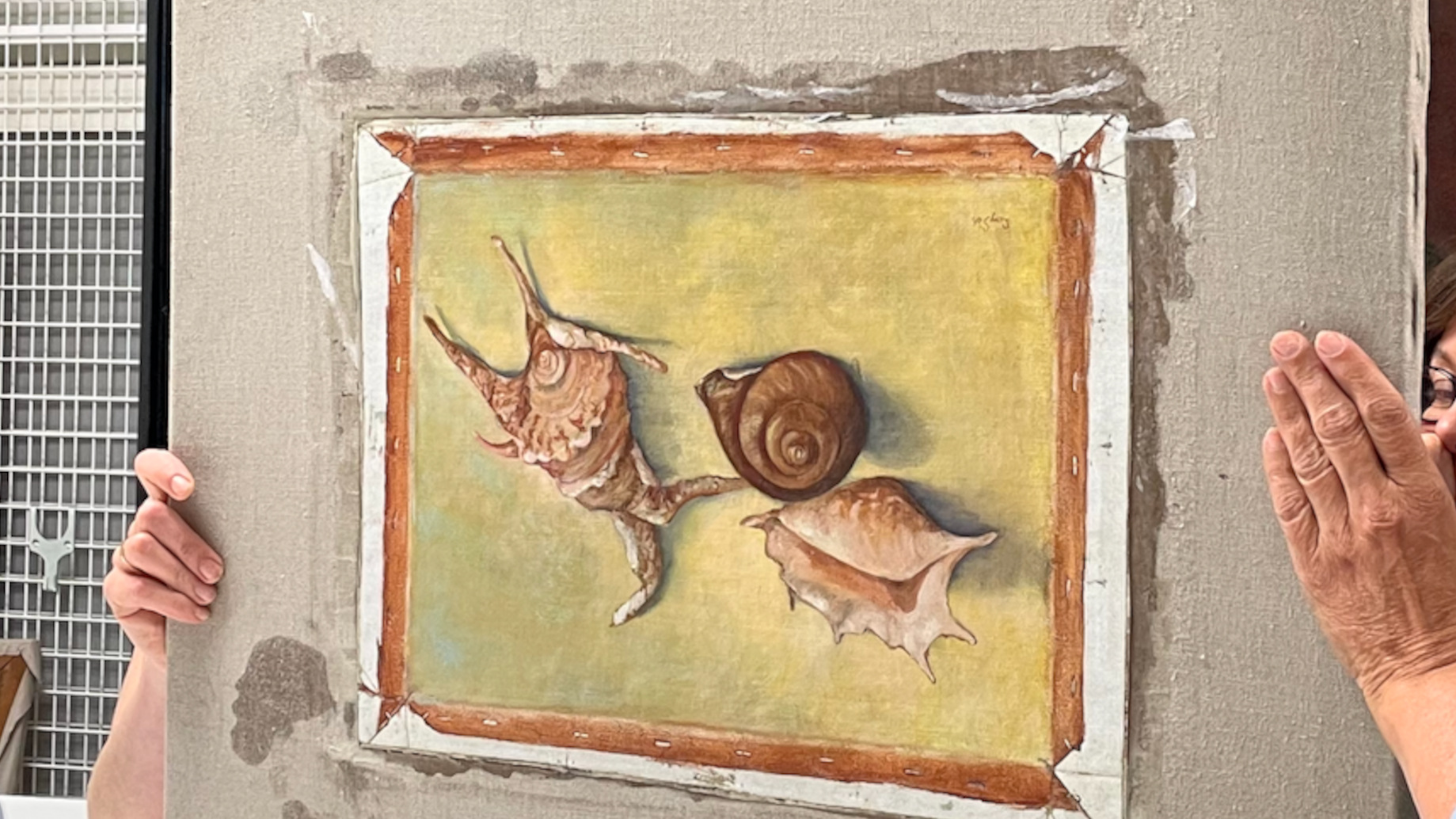
Lining is a major structural intervention that aim to reinforce a weakened canvas using a new canvas. There is two type of lining, the traditional and the modern lining. These techniques share the same fundamental objective: to guarantee stability and longevity of an artwork whose original support can no longer ensure its load-bearing function. The main difference between these two methods lies in the materials employed and application processes.
Traditional lining uses natural materials and adhesives (animal glues, flours, wax and natural resins), particularly adapted to antique artworks or presenting compatibility with these substances. Modern lining uses modern synthetic materials and adhesives, generally more appropriate for contemporary artworks or pieces sensitive to traditional adhesives. The choice between these two techniques depends on a meticulous analysis of the artwork, its constitutive materials, its conservation state and its specificities.
Traditional lining
What is it for?
Traditional lining is necessary when the canvas is too brittle and can no longer be properly stretched on a stretcher. It’s also required facing a large number of tears where simple reinforcement patch application wouldn’t suffice to guarantee the artwork’s stability.
This intervention constitutes a last resort treatment in conservation, always carried out after meticulous evaluation of the artwork’s state and possible alternatives.
How I proceed at Atelier CROMA?
As a conservator, I pay particular attention to the artwork specificities during traditional lining:
- Meticulous preparation: First, I remove the canvas from its stretcher after performing several essential preparatory steps (cleaning, paint layer protection, provisional tensioning, fragile zone consolidation, support accident treatment).
2. Application of an intermediate layer: To guarantee intervention reversibility, I apply an intermediate layer on the original canvas, acting as a protective barrier.
3. Support assembly: The original canvas and lining canvas are carefully glued together using natural adhesives perfectly compatible with the artworks’ constitutive materials.
4. Progressive re-tensioning: The artwork is then progressively re-tensioned on an adapted stretcher.
Traditional lining advantages are multiple: it allows recovering excellent flatness, offers a very satisfying aesthetic rendering and uses natural materials that integrate harmoniously with the artwork’s original components.
When to consider traditional lining?
Traditional lining may be necessary in the following cases:
- Canvas become brittle and friable with time
- Multiple tears compromising structural integrity
- Artwork having suffered humidity-related damage having weakened fibers
Modern lining
What is it for?
Modern lining, like traditional lining, aims to reinforce a weakened canvas through application of a new canvas on the back. This technique is also employed when the canvas is too fragile to support tensions necessary for mounting on stretcher.
Modern lining is distinguished by use of modern synthetic materials, proposing an alternative adapted to certain specific problematics of contemporary artworks. A notable advantage of modern lining is that it can be carried out opaquely or transparently according to the artwork’s needs and conservation requirements.
How I proceed at Atelier CROMA?
As a specialist in modern and contemporary artworks, I adapt my methodology to specific materials used by 20th and 21st century artists:
1. Pre-sizing of lining canvas: I meticulously apply synthetic adhesives selected for their compatibility with contemporary materials.
2. Application of an intermediate layer: To guarantee future intervention reversibility, an insulating layer is applied.
3. Adhesive reactivation and assembly: The adhesive is reactivated using an appropriate solvent, then the original canvas is carefully positioned and glued.
4. Final sealing: The operation ends with lining sealing with controlled heat and pressure input, adapted to modern material sensitivities.
When to favour modern lining?
Modern lining can be preferred to traditional lining in several situations:
- Contemporary artworks with synthetic materials
- Need for less invasive intervention
- Need to maintain back visibility (transparent lining)
- Sensitive artworks to traditional adhesives
- Modern paintings with binders sensitive to humidity
An ecological approach at the heart of my interventions
At Atelier CROMA, environmental aspect is a central concern that guides my technical choices for lining. My ecological approach manifests at several levels:
Rigorous material selection
Favor canvases produced respecting the environment
Use adhesives with low environmental impact when the artwork nature permits
Opt for biodegradable solutions when the artwork characteristics authorize it
Avoid toxic compounds or products with strong ecological impact
Responsible work methods
Reduce energy consumption by favoring cold techniques when possible
Limit use of polluting solvents by replacing them with more ecological alternatives
Optimize product dosing to minimize waste
Implement a recycling system for canvas scraps and adhesive residues
Intervention durability
Design lasting solutions requiring fewer future interventions
Favor materials stable over time to avoid frequent replacements
Adopt a preventive approach that anticipates material aging
This ecological approach never compromises quality or intervention effectiveness, but rather represents added value that fits within a responsible vision of conservation for future generations.
Why choose Atelier CROMA for lining of your artworks?
As a conservator specialized in modern and contemporary art, I offer you:
Pointed expertise in treating modern and contemporary supports
In-depth knowledge of materials
innovative used by artists
Custom approach adapted to each artwork
Constant ecological commitment in my interventions
Particular sensitivity to mixed techniques and composite materials
Lining is a crucial intervention that, although often invisible to the viewer, largely condition the artwork’s long-term conservation. This techniques require solid technical expertise and in-depth knowledge of materials, two qualities that I put at your artworks’ service at Atelier CROMA.
Request a personalised estimate
You want to know more about lining possibilities for your artwork? Don’t hesitate to contact me to obtain a personalised estimate and benefit from advice adapted to your particular situation.